Reading a Pool Before You Point Hardware at It
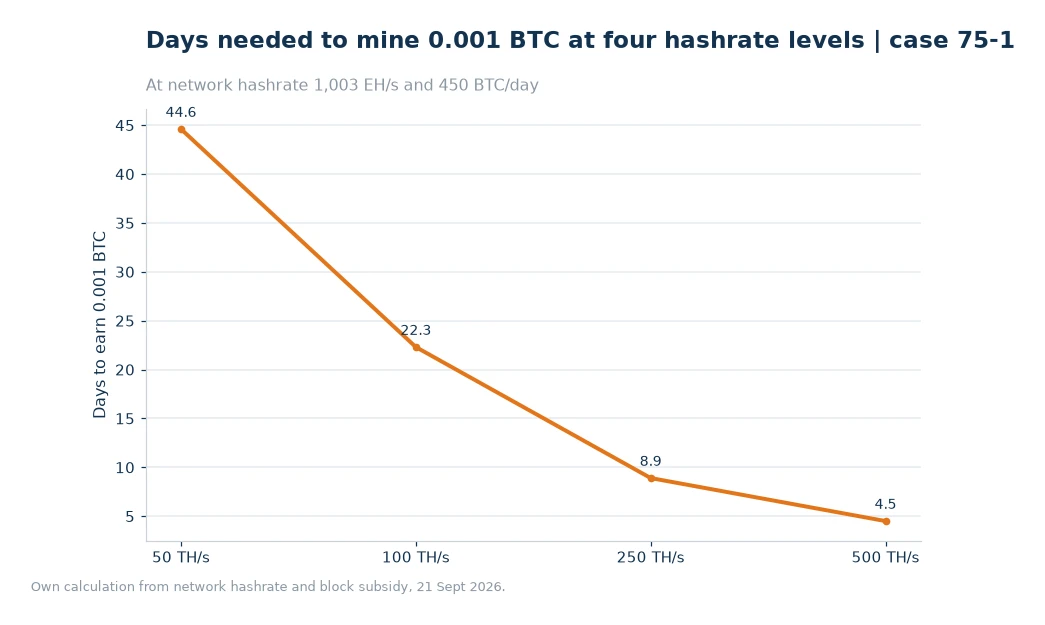
Choosing a pool takes less time than choosing a machine, and it is easier to get wrong. A 50 TH/s rig credits 0.00002243 BTC a day under the 21 September 2026 reading, so 0.001 BTC takes 44.6 days. Whether that arrives on schedule depends on facts the pool publishes and on settings you control.

Key takeaways
- 50 TH/s earns 0.00002243 BTC a day; 0.001 BTC is a 44.6-day project at that rate.
- At 500 TH/s the same target takes 4.5 days, so a small rig is a slow but cheap way to test a pool.
- Pool hashrate sets your slice of rewards, not their size; the network total sets the size.
- Pool Luck describes past block discovery, so a short window of it says little about a pool's reliability.
Begin with your own rate per terahash
Before comparing pools, work out what one terahash is worth on the day you are deciding. The network produces 450 BTC a day and hashes at about 1,003 EH/s, which puts a single terahash at 0.0000004486 BTC a day. Multiply by your hashrate and you have a number that is independent of which pool you choose. Every pool comparison is really a comparison of how close to that number the credits land.
A small machine makes a good test case precisely because the numbers are small and slow. At 50 TH/s you can watch a full week of credits and check every one against the arithmetic without drowning in data. If the first week's total matches the prediction within a few percent, the pool, the wallet and the worker are all configured correctly. If it does not, the cause is easier to isolate at 50 TH/s than at 5 PH/s.
The target matters too. A 0.001 BTC goal at 50 TH/s spans six weeks, which is long enough to see a difficulty adjustment and a couple of price moves. That is a feature: it tests the pool across changing conditions rather than across a lucky afternoon.
What the pool figure tells you, and what it does not
A published hashrate is a measure of how much work the pool coordinates. It tells you how often the pool finds blocks as a whole, which is useful context for the variance you should expect. It does not tell you that your own rewards will be larger. Your share of the pool's output is your hashrate divided by the pool's hashrate, and the pool's output is its share of the network multiplied by 450 BTC a day. The pool's hashrate cancels out of the first fraction and reappears in the second.
What does not cancel out is reliability. A pool with a stable hashrate and a clean credit history is easier to plan around than one whose hashrate halves every few weeks, because the second pool's block discovery becomes lumpier and its fee changes are harder to predict. Watch the trend for a month rather than the level on any given day.
The published Statistics page is the place to cross-check network figures, and the pool state page shows the pool's own hashrate beside them. Comparing the two gives you the pool's share of the network, which is the number that governs how regularly blocks arrive.
Three checks that take ten minutes
The first is the fee page. Read which component each listed rate applies to, and check whether the default scheme is the one you want. A pool quoting a single blended percentage is either simplifying or hiding something; the schedule should separate the block-reward component from the transaction-fee component, because the two carry different listed rates under PPS+.
The second is the payout history on your own account, once you have one. Credits should be regular and traceable to a rate, not mysterious round numbers. The third is the guide for your specific coin, which should state the connection details, the scheme definitions and the confirmation rules in language you can check against the dashboard.
| Day | BTC mined | Share of target | USD at $84,692 |
|---|---|---|---|
| 7 | 0.00031402 | 31.4% | $26.59 |
| 14 | 0.00062804 | 62.8% | $53.18 |
| 21 | 0.00094206 | 94.2% | $79.78 |
| 22.3 | 0.00100038 | 100% | $84.72 |
The last row lands just above the target because 22.3 days is a rounded figure. In practice the target is crossed during the twenty-third day, which is why daily tables and day-fraction tables disagree by a few percent at the boundary.
Worked example
- Emission: 3.125 BTC per block × 144 = 450 BTC.
- Terahash value: 450 ÷ 1,003,000,000 = 0.0000004486 BTC per day.
- At 50 TH/s: 50 × 0.0000004486 = 0.00002243 BTC daily.
- Days to 0.001 BTC: 0.001 ÷ 0.00002243 = 44.6 days.
- 100 TH/s doubles the daily rate to 0.00004486 and halves the wait to 22.3 days.
- 250 TH/s: 0.00011215 BTC a day, so the target takes 8.9 days.
- 500 TH/s: 0.00022430 BTC a day, so the target takes 4.5 days.
- In dollars, 0.001 BTC is $84.69 at $84,692, which is the value the six-week project is chasing.
The commitment question
Once a pool clears the basic checks, the remaining risk is your own setup. Three settings decide whether the first month matches the arithmetic: the coin, the payout address and the scheme. Get the coin wrong and the machine hashes for nothing. Get the address wrong and the credits leave your control. Get the scheme wrong and the credits arrive on a rhythm you did not plan for.
It is worth writing those three settings on a card and taping it inside the enclosure. A firmware reset can clear pool configuration, and the person restoring it at midnight is rarely in the mood to search a support forum. The same card should carry the worker name convention, so a replacement machine joins as a replacement rather than as a mystery worker.
The ViaBTC Pool Hashrate page is the last check before you commit, because it tells you how much company you will keep and how the pool's share of the network stands today. A pool with a large share finds blocks often, which smooths a PPLNS miner's experience; a pool with a small share delivers the same expectation with wider swings.
The first month, audited
Keep a daily note of credited BTC, reported hashrate and any restart. At the end of the month, divide total credits by the average reported hashrate and by the days elapsed. You now have your own BTC-per-terahash-day figure, which you can compare with the network-derived 0.0000004486. A gap of a few percent is uptime and rejects; a gap above 10% needs an explanation.
Do the same for Pool Luck if the pool publishes it. If your credit history looks lumpier than the luck figure suggests, the likelier explanation is your own uptime or a scheme change, not a dishonest number. Attribution is the whole exercise: a miner who can explain the gap can fix it, and one who cannot will keep changing pools in search of a problem that follows them.
Frequently asked questions
How long does 0.001 BTC take at 50 TH/s?
About 44.6 days at the 21 September 2026 network reading, because 50 TH/s credits 0.00002243 BTC a day. At 500 TH/s the same target takes 4.5 days.
Should I pick a pool by its hashrate?
Only as context. Expected income depends on your share of the network, not on the pool's size, but a larger pool finds blocks more regularly and therefore delivers a smoother PPLNS experience.
What should I check in the first week?
That the credited BTC matches the daily rate times the hashrate the pool reports, that rejects stay low, and that the payout address is the one you intended. Three checks, one week, and the rest of the month is routine.
Test small, then scale
A six-week run at 50 TH/s costs almost nothing in forgone income and answers every question that matters about a pool: does it pay what it says, does it pay when it says, and does the dashboard explain itself. The fee schedule completes the picture by showing what each payout scheme costs and which component the rate applies to.
Sources: ViaBTC's pool state, statistics and pricing pages, for pool hashrate, network figures and the listed 4% and 2% rates[1]. Every rate was read on 21 Sept 2026 — network 1,003 EH/s, difficulty 132.76 T, subsidy 3.125 BTC, 144 blocks a day, BTC $84,692. The 0.001 BTC timeline assumes no downtime. Published 22 Oct 2026.