PV Wire Jacket Colours and UV Exposure
Black and red are the two colours the maker lists for its 1500 V solar cable, and the colour is not a coat of paint on top of the insulation. It is part of the compound, which is why it matters when a cable spends 25 years or more in the sun. KUKA CABLE arranges a 2,000-hour xenon lamp test on its solar cables, equivalent to about 360 weathering cycles, to see how that compound behaves.
Key takeaways
- The 1500 V product page lists two jacket colours, black or red.
- Weathering is tested with a 2,000-hour xenon lamp run, equivalent to about 360 weathering cycles.
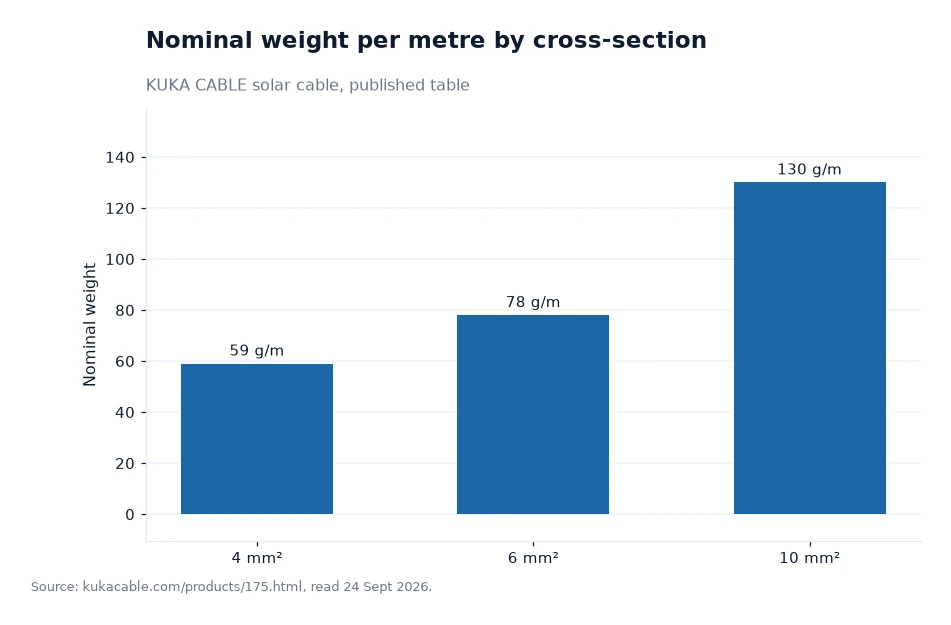
- Weight per metre rises steeply with size: 59 g/m at 4 mm², 78 g/m at 6 mm² and 130 g/m at 10 mm².
- The UV accelerated weathering test sits on the maker's published laboratory test list next to water resistance and abrasion.
What a jacket colour really is
A jacket colour comes from pigment dispersed in the sheath compound at the extrusion stage. That single sentence explains most of the practical consequences. The pigment travels with the same cross-linking process as the rest of the sheath, so once the electron beam has done its work the colour cannot be changed, buffed off or renewed. It also means the colour choice sits in the formulation, and a supplier asked for a third colour is being asked to run a different compound rather than to paint a drum.
Two colours are listed on the product page for the 1500 V design: black or red. That is enough for the job the colours usually do on a roof, which is distinguishing polarity on a DC circuit where both conductors may otherwise look identical after a season in the sun.
Why UV exposure is the slow failure
Ultraviolet light breaks polymer chains, and a broken chain shows up as a chalky surface, then as a crack, then as a path to earth. The maker's answer to that process is published in three places. First, the 2,000-hour xenon lamp test, described as being arranged on KUKA solar cables and equivalent to about 360 weathering cycles that simulate intense sunlight, humidity and ozone. Second, a UV accelerated weathering test on the laboratory test list. Third, the statement that the TUV EN 50618 benchmark for UV stability is the floor the maker aims above.
The two-colour point matters here because dark compounds and light compounds age differently. Black absorbs more of the spectrum and is the customary choice for outdoor cable; a red jacket carries different pigment loading and is normally used on the same insulation and sheath material so that only the colour differs. If a project needs one colour for the whole array, say so before the order, because the extruder run has to be set up for it.
Weight, handling and the drum you get
Weight per metre is published for every size on the cross-section table, and it is not a trivial line. At 4 mm² the figure is 59 g/m, at 6 mm² it is 78 g/m and at 10 mm² it is 130 g/m. Multiply the 10 mm² figure by the other two and the 10 mm² cable is roughly 2.2 times the weight of the 4 mm² for the same length, which my own arithmetic on the printed numbers works out as, and that changes how a tray, a rail and a person's shoulder are loaded.
- 4 mm² — 59 g/m, nominal overall diameter 5.5 mm.
- 6 mm² — 78 g/m, nominal overall diameter 6.0 mm.
- 10 mm² — 130 g/m, nominal overall diameter 7.5 mm.
The site does not publish drum lengths or drum weights, so a roll plan has to come from the supplier. Ask for the weight per metre of the exact size and the drum length you are being offered, and check the two together against the lifting equipment on site.
Testing a jacket, not just trusting it
The published test list for this pv wire includes UV accelerated weathering, cable abrasion testing and a water resistance test, and the finished cable also takes a flame test in which a single cable is exposed to burning at 800 °C for one minute and is expected to self-extinguish. The 1500 V design is listed against TUV 2PfG 1169/08.2007, EN 50618:2014 and IEC 62930, with CPR fire rating and AD8 waterproofing rating named as the regional requirements the client highlights.
Read as a set, those checks answer the questions a colour raises. Will the jacket still be distinguishable after years outdoors? Does the sheath resist abrasion where it passes over a rail edge? Does water reaching a nick stay put? The test pages set out each one, and the solar cable topic section explains how construction choices affect them.
Published jacket and section data
| Cross-section | Insulation thickness | Sheath thickness | Nominal weight | Jacket colour |
|---|---|---|---|---|
| 1.5 mm² | 0.7 mm | 0.8 mm | 34 g/m | Black or red |
| 2.5 mm² | 0.7 mm | 0.8 mm | 45 g/m | Black or red |
| 4 mm² | 0.7 mm | 0.8 mm | 59 g/m | Black or red |
| 6 mm² | 0.7 mm | 0.8 mm | 78 g/m | Black or red |
| 10 mm² | 0.7 mm | 0.8 mm | 130 g/m | Black or red |
Worked example
A 200 m run of 6 mm² is the easiest way to see why the weight line matters. At 78 g per metre, 200 metres comes to 15,600 g, which is 15.6 kg. Run the same 200 metres in 10 mm² at 130 g per metre and the figure is 26,000 g, or 26 kg. Both totals are mine, produced by multiplying a published weight by a chosen length, and the 10.4 kg difference is roughly a bag of cement that someone has to lift onto a rail.
Standards do not cover drum handling, so this is the part of the specification the buyer writes. If a run is long and the access is awkward, splitting it into two drums changes everything about the installation and nothing about the cable.
Frequently asked questions
Does the jacket colour change how long a PV cable lasts outdoors?
Colour is pigment inside the same cross-linked compound, so the material, not the shade, does most of the work. What the maker publishes is a 2,000-hour xenon lamp test equal to about 360 weathering cycles, a UV accelerated weathering test on the laboratory list, and a note that the TUV EN 50618 UV benchmark is treated as a floor. Ask for the weathering result that applies to the colour you are ordering.
Which colours are available for this PV wire?
The 1500 V solar cable page lists black or red, on a design with electron-beam cross-linked XLPO insulation and sheath. Twin-core versions exist in the wider solar range, so polarity marking can also be handled by construction rather than by colour alone. Confirm the colour on the order line, because the jacket is formed during extrusion and cannot be altered afterwards.
Ordering checklist
Write the colour on the order line for each size, not once for the whole batch. Ask for the weight per metre and the drum length together, then check the two against the lifting plan. Confirm whether the run will be single-core or twin-core before the connector order goes out, since the two constructions are crimped and dressed differently. Finally, request the weathering and abrasion results for the size and colour you are buying, and keep them with the project file next to the certificate.
UV and colour statements in this piece, and the weights beside them, match the manufacturer's own website wording, read in full on 24 Sept 2026[1].