Multi-Coin Mining: BTC, LTC and KAS in One Dashboard
Putting BTC, LTC and KAS on one screen is a unit problem before it is a layout problem. SHA-256 hashrate is quoted in TH/s, Scrypt in GH/s and kHeavyHash in PH/s, so three columns that look identical can describe very different amounts of work. The only comparable number is money: at difficulty 132.76 T, one TH/s of SHA-256 produces about 0.0000004735 BTC a day, roughly $0.04 at a BTC price of $85,294.

Key takeaways
- Three chains, three units: one TH/s of BTC work pays about $0.04 a day, while one GH/s of LTC work pays about $0.08 — an LTC unit that is a thousand times smaller.
- Network output is the base of every estimate: 450 BTC, 3,600 LTC and 1,885,832 KAS are produced each day across their networks.
- PPS+ settles hourly at current difficulty, so a BTC row refreshes 24 times a day, while KAS rows move in minutes because blocks arrive about 10 times a second.
- Merged mining makes the LTC column a two-asset column: DOGE is paid on top of the LTC reward and has to be valued separately.
Three chains, three definitions of hashrate
SHA-256, Scrypt and kHeavyHash are different problems solved by different silicon, and each carries its own hashrate scale. Bitcoin reports about 950.3 EH/s, which is the same statement as 950,300,000 TH/s. Litecoin's Scrypt network reports roughly 2.71 PH/s, or 2,710,000 GH/s. Kaspa reports about 340.2 PH/s. A dashboard that prints those three figures in a single column is technically accurate and practically useless.
Convert each one to money and the picture sharpens. One TH/s of SHA-256 pays about 0.0000004735 BTC a day, which is $0.04. One GH/s of Scrypt pays about 0.00132626 LTC, which is $0.08 at $60.68. On the Kaspa network, a whole PH/s pays roughly $237 a day. The unit is not a formatting detail: a miner reading the word terahash on a Scrypt row is looking at a thousand times more work than the same word on a SHA-256 row.
That is why the honest layout for a multi-coin account is one row per coin, with the native unit in one column and USD per day in another. The native unit tells you what the machine is actually hashing. The dollar column tells you what that work is worth this week, which is the question most operators are really asking.
What daily output looks like side by side
Every estimate below starts from network-wide output, because that is the fixed pie each miner divides. Your share of network hashrate multiplied by daily issuance gives gross income; the listed fee then applies to the specific component named in the fee schedule, not to the total.
| Chain and algorithm | Native unit | Network output per day | Gross income per unit | What moves it |
|---|---|---|---|---|
| BTC, SHA-256 | TH/s | 450 BTC (3.125 BTC subsidy across 144 blocks) | 0.0000004735 BTC, about $0.04 | Difficulty 132.76 T; next adjustment estimated at +1.90% |
| LTC, Scrypt with merged DOGE | GH/s | 3,600 LTC (6.25 LTC across 576 blocks) | 0.00132626 LTC, about $0.08 | LTC difficulty 94,799,394; DOGE valued on its own |
| KAS, kHeavyHash | PH/s | 1,885,832 KAS, about $80,768 | roughly $237 per PH/s | Network hashrate near 340.2 PH/s; reward 2.18 KAS |
The third and fourth columns are the ones worth staring at. Network output is a constant you cannot influence. Per-unit income is the number that turns your hardware list into a forecast, and it is the only number in the table that is comparable across the three rows.
Worked example
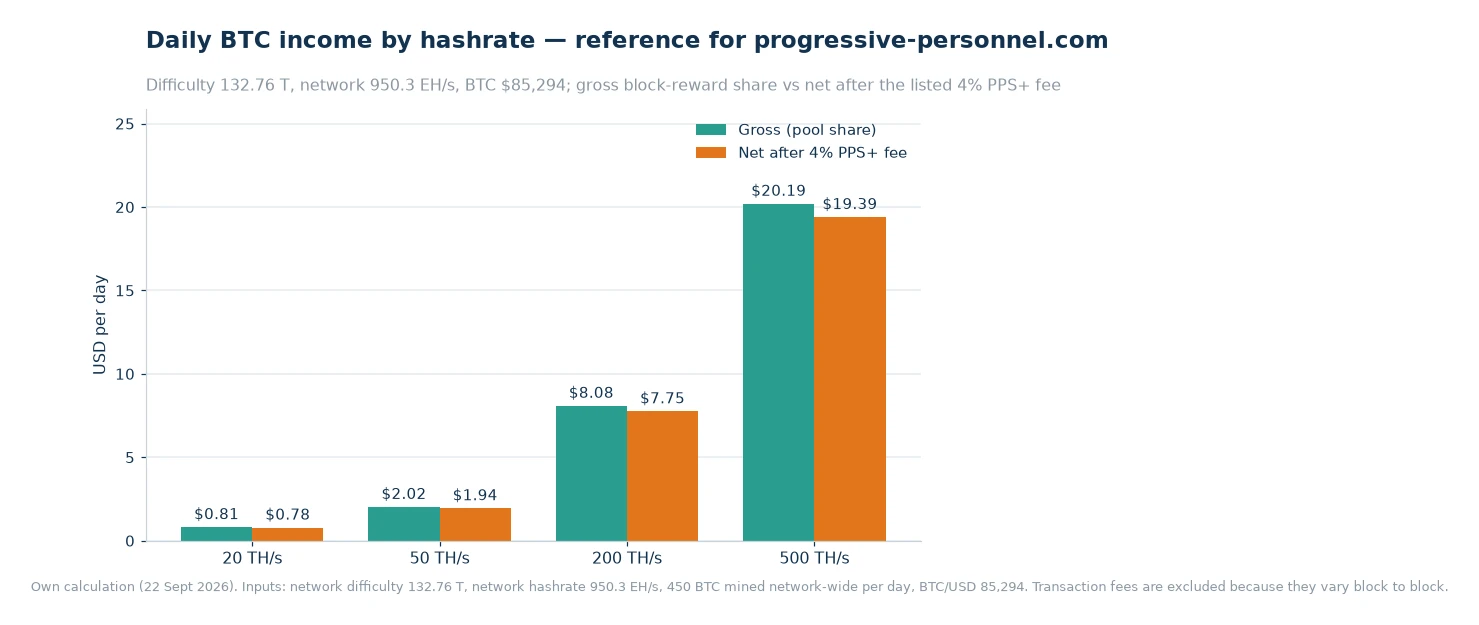
Take a 500 TH/s SHA-256 machine. Step one is the share of the network: 500 divided by 950,300,000 TH/s comes to about 5.26 × 10⁻⁷. Step two is gross daily income: the same proportion of the 450 BTC mined network-wide each day, which is about 0.00023675 BTC, or $20.19 at $85,294. Step three is the listed fee: the 4% PPS+ fee applies to the block-reward component, worth about $0.81 here, which leaves $19.39.
Now run the same three steps on the other chains. A Kaspa rig at 0.5 PH/s earns about $118.50 a day gross at roughly $237 per PH/s. A Scrypt rig at 10 GH/s earns about 0.0132626 LTC a day, near $0.80, with any DOGE produced by merged mining valued on top and on its own schedule. Nothing in that comparison can be made from hashrate alone; the dollar figures are what a hardware decision rests on.
Before committing capital, push the same inputs through the Profit Calculator, which takes a coin price, a network difficulty, a PPS fee and an effective hashrate and returns a daily estimate that already includes merged-mining output.
Where multi-coin accounts go wrong
The first mistake is comparing the wrong column. A miner who sorts a dashboard by hashrate will conclude that the Scrypt machines are running thousands of times faster than the SHA-256 units, because 10 GH/s sounds smaller than 500 TH/s until the fee-adjusted dollar column is read alongside it.
The second mistake is treating difficulty as static. Bitcoin's next adjustment is estimated at +1.90%, which trims every BTC row by roughly that share; LTC and KAS move on their own cadences and their own price feeds. A forecast built on one week of numbers will be wrong within a month unless it is rebuilt, which is the whole argument for keeping the calculation in a tool rather than a spreadsheet cell nobody revisits.
The third is fee confusion, and it is the most expensive one. The listed 4% on the PPS+ side covers the PPS-settled block reward; transaction fees are distributed on a separate basis and carry a listed 2%, and the PPLNS option applies a listed 2% to both components together with settlement after 6 confirmations over the last 5 difficulty rounds. A ViaBTC Mining Guide is worth reading once with the fee schedule open in a second tab, because a single misunderstanding there misprices every coin in the account.
Confirm the plumbing too. The pool statistics view shows pool hashrate, network hashrate, difficulty and miner counts in one place, which is how you check that the hashrate your own dashboard reports is the hashrate the pool actually counts.
Frequently asked questions
Can one machine mine BTC and LTC at the same time?
No. SHA-256 and Scrypt are different algorithms and need different chips, so a single miner sits on one row of the dashboard. The multi-coin view exists because accounts hold several machines, not because hardware switches between chains.
Why does the KAS row move before the BTC row does?
Block cadence. Kaspa produces about 10 blocks every second, so pool figures change within minutes, while Bitcoin produces one block roughly every 10 minutes and PPS+ settles hourly at current difficulty.
Does merged mining double LTC income?
No. Merged mining adds DOGE as a second output produced by the same Scrypt work. The LTC reward itself is unchanged, and the DOGE value depends on its own price and must be tracked separately in your records.
Set the units once, then read the money column
Write down the native unit for each chain in the account and leave it alone. BTC is counted in TH/s, LTC in GH/s and KAS in PH/s, and mixing those scales is the source of most bad comparisons. Then build one habit: read the fee-adjusted dollar column, not the hashrate column. Re-run the inputs after each difficulty adjustment, keep merged-mining output on its own line in the records, and treat any figure that cannot be traced back to network output, an exchange price and a listed fee as an estimate rather than a number.
Sources and rates: the ViaBTC listed schedule for PPS+ and PPLNS[1]. Network inputs — BTC difficulty 132.76 T with a network hashrate near 950.3 EH/s, LTC difficulty 94,799,394 with a network near 2.71 PH/s, and a Kaspa emission of 1,885,832 KAS a day at about 340.2 PH/s — were read from public chain data and market feeds at the same date, together with BTC $85,294, LTC $60.68 and KAS $0.042829. Every figure above is arithmetic on those inputs; difficulty and price move, so none of them is a promise of earnings. read 22 Sept 2026.